Montenegro Digital Nomad Visa
Digital Nomad Temporary Residence Permit
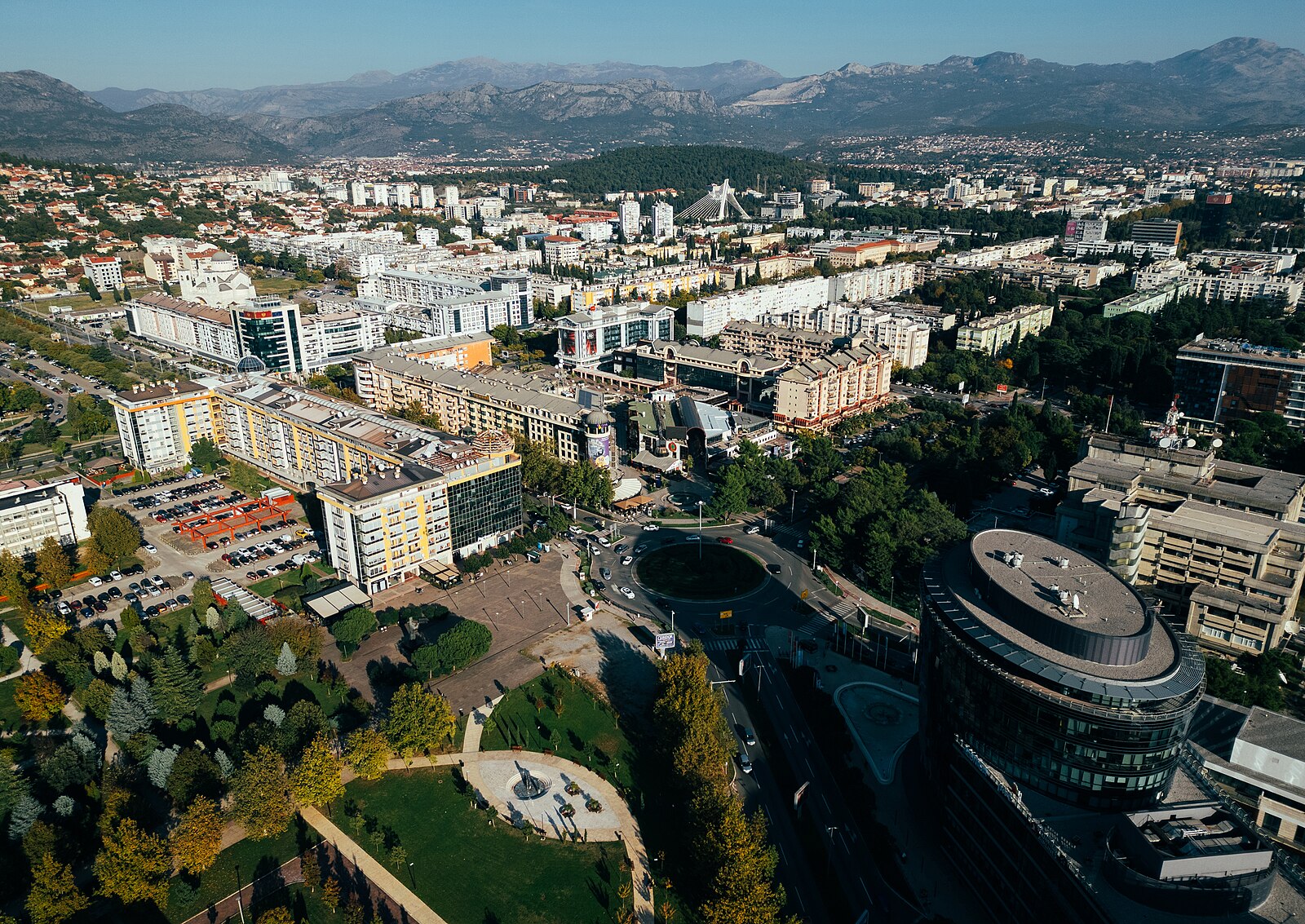
Overview
Nomad Score
Our unique composite ratingFees, processing, online application
Duration, renewability, family
No tax on foreign income
Safety, healthcare, development
Internet, English, tap water
Nomad Score is calculated from visa accessibility, stay flexibility, tax benefits, living quality (UNDP, UNODC, WHO data), and digital infrastructure. Updated 2026-09-15.
Application Process
Prepare Documents
Gather 6 required documents including valid travel document, proof of remote work for a foreign company or own company outside montenegro
Submit Application
Apply in person at the immigration office
Processing
Wait Up to 40 days for a decision
Approval
Receive your visa approval
Arrive & Register
Register within Within 24 hours of arrival if staying at private accommodation
Prepare Documents
Gather 6 required documents including valid travel document, proof of remote work for a foreign company or own company outside montenegro
Submit Application
Apply in person at the immigration office
Processing
Wait Up to 40 days for a decision
Approval
Receive your visa approval
Arrive & Register
Register within Within 24 hours of arrival if staying at private accommodation
How to apply online: annotated screenshots
Numbered markers on official portal screenshots show exactly where to click and what to enter.
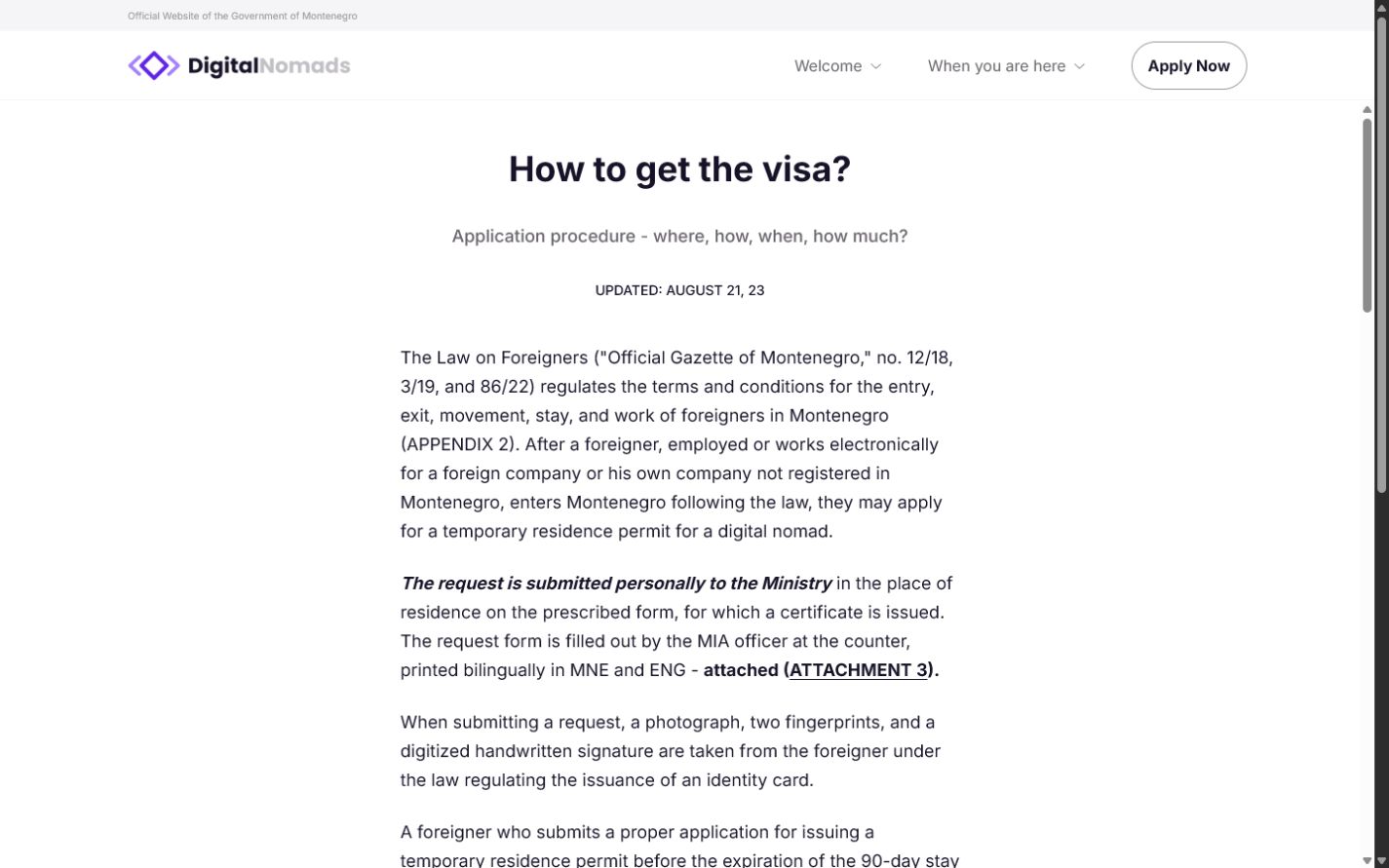
- Use the Government of Montenegro Digital Nomads page titled How to get the visa?.
- The request is submitted personally to the Ministry at the applicant's place of residence.
Source: Government of Montenegro — Digital Nomads · Captured: 2026-07
Visa Requirements
Financials
- Income Proof
Income must be at least three times the national minimum wage and must come from outside Montenegro. On the 2026 figures that is about EUR 1,800 a month without a higher education degree and about EUR 2,400 with a bachelor's degree or above. Employment or company documents plus bank statements are required.
- Income Type
Formula: three times the Montenegrin minimum wage, tiered by education level
Background & Health
- Health Insurance Required
- Background Check Required
- Minimum Age 18+ years old
Advantages
- • No visa required for 90 days (for most nationalities)
- • No income requirement for short stays
- • No application process
- • Uses euro (convenient, no currency exchange)
- • Stunning Adriatic coast and Bay of Kotor (UNESCO)
- • Low cost of living ($1,000-1,500/month)
- • Favorable tax rates (9% corporate, 9-15% personal)
- • Popular visa run destination (to Albania/Bosnia)
- • Strong expat community (Russian, Serbian, Western)
- • Mediterranean climate
- • Small country - easy to explore
- • Pathway to residency permit
Disadvantages
- • Application must be filed in person after lawful entry
- • Not an EU member (EU candidate)
- • Visa run culture creates uncertainty
- • Small country - limited cities
- • Summer tourist season very crowded and expensive
- • Infrastructure still developing
- • English less common outside tourist areas
- • Healthcare system basic
- • Banking difficult for tourists
- • 10-year path to citizenship (long)
Policy Change History
Tracking visa requirement changes over time to help you stay informed.
Income bar confirmed as 3x the national minimum wage, tiered by education
About EUR 1,800 a month without a higher education degree and EUR 2,400 with one, based on the statutory minimum wage of EUR 600 and EUR 800.
Source: Government of Montenegro
Entry now models the official digital-nomad temporary residence permit
The government route allows a permit of up to two years, extendable by up to two more, filed in person at the Ministry of Interior. Visa-free tourist stays are no longer treated as the nomad route.
Source: digitalnomads.gov.me
Tax & Legal
Foreign Income
Montenegro generally does not tax foreign-sourced income for holders of this visa, making it highly attractive for remote workers.
Territorial-like system - foreign income generally not taxed for non-residents
Local Income
Income earned from local Montenegro sources is taxable at standard rates.
Montenegro has favorable tax rates (9% corporate, 9-15% personal income). Foreign-sourced income for non-residents typically not taxed. Tax residency triggered at 183+ days. Many digital nomads stay under 183 days or do visa runs to avoid tax residency.
Living in Montenegro
All ratings use a unified A–D scale. A = best for digital nomads in each category.
Affordable
Numbeo Cost of Living Index: 38/100 (NYC=100, lower=cheaper)
Safe
UNODC Homicide Rate: 2/100k population
Adequate
WHO Universal Health Coverage Index: 60/100
Excellent for Remote Work
Ookla Speedtest: 118 Mbps median download
High Development
UNDP Human Development Index: 0.835
Mediterranean coast, continental mountains — warm summers, cold mountain winters
WHO/UNICEF JMP
Basics recommended
Climate classification
Sources: UNDP HDR 2025 · UNODC Homicide Data · WHO UHC 2023 · Numbeo · Ookla · WHO/UNICEF JMP. Updated 2026-08.
Common Questions
What does the Digital Nomad Temporary Residence Permit cost to apply for?
Why does the income requirement for Montenegro keep changing?
How long can I actually stay in Montenegro?
Does the Digital Nomad Temporary Residence Permit cover a spouse and children?
Will I pay tax in Montenegro on money earned abroad?
Do I have to apply in person for the Digital Nomad Temporary Residence Permit?
Can this route eventually lead to a Montenegro passport?
What do I need to renew the Digital Nomad Temporary Residence Permit?
What trips up most Digital Nomad Temporary Residence Permit applications?
Where to Live & Work
Budva
Montenegro's tourist capital. Medieval walled Old Town, sandy beaches, vibrant nightlife, marina. Most popular with digital nomads and expats.
Popular Neighborhoods
Old Town (Stari Grad)
Medieval walled city, charming but touristy, very seasonal
Best for: Summer stays and those wanting historic center
Budva Riviera (suburbs)
Residential areas, beaches, quieter than center
Best for: Long-term stays and families
Coworking Spaces
Seasonal operation, good community
Many work from cafes - limited formal coworking
Local Tips
- ● Peak season (July-August) is crowded and expensive - rent doubles
- ● Shoulder season (May-June, September) ideal - warm and affordable
- ● Old Town beautiful but very touristy in summer
- ● Beach scene and nightlife are main draws
Kotor
UNESCO World Heritage site. Stunning bay surrounded by mountains, medieval Old Town, dramatic scenery. More cultural than Budva, popular with cruise ships.
Popular Neighborhoods
Old Town
Medieval fortress city, steep stairs, charming but touristy
Best for: Culture lovers and scenic beauty seekers
Dobrota (waterfront suburb)
Quiet waterfront, residential, local vibe
Best for: Those wanting Kotor Bay beauty without tourist crowds
Coworking Spaces
Work from cafes with bay views - no formal coworking yet
Local Tips
- ● Cruise ships bring daily crowds in summer - mornings are quieter
- ● Climb the fortress walls for stunning views (1,350 steps)
- ● More cultural and less party-focused than Budva
- ● Bay of Kotor is one of Europe's most dramatic settings
Podgorica
Capital and largest city. Most affordable, least touristy, base for administrative tasks. Not scenic but practical for long-term stays and residence permits.
Popular Neighborhoods
Center (Centar)
Urban, commercial, soviet-era and modern mix
Best for: Budget-conscious nomads and admin tasks
Coworking Spaces
Small community, affordable
Local Tips
- ● Podgorica is 30-40% cheaper than coast
- ● Not scenic - functional capital city
- ● Hot in summer (35°C+), better in spring/fall
- ● Good base for applying for residence permits
General Tips for Montenegro
- ● Montenegro uses the euro (€) despite not being in the EU
- ● Cost of living: $1,000-1,500/month (higher in summer on coast)
- ● Visa runs to Albania (Shkodër) or Bosnia (Trebinje) are common - 1-2 hours
- ● 90/180 rule means you can spend max 90 days in any 180-day period
- ● Large Russian expat community - Russian widely understood
Prices are approximate and based on publicly available data as of 2026-04. Actual costs vary by individual circumstances and market conditions.
After You Arrive
PIB (Poreski Identifikacioni Broj)
Not required for tourists. Needed for business registration or temporary residence
Bank Account
Can open: Yes
Recommended: CKB (Crnogorska Komercijalna Banka), NLB Montenegro, Erste Bank
Alternatives: Wise and Revolut widely used - much easier than local banks. Montenegro uses euro so transfers are easy.
Housing Search
Main platforms: Halo Oglasi Montenegro, Nekretnine.me, Airbnb for short-term, Facebook Groups (Expats in Montenegro, Budva/Kotor groups)
- • Summer rental prices 50-100% higher than winter
- • Long-term winter rentals much cheaper
- • Typical deposit: 1 month
- • Contracts often informal - ensure written agreement
What Nobody Tells You
Montenegro has no formal digital nomad visa, but the 90/180 visa-free rule (like Schengen) is used by many nomads. The visa run culture is well-established - cross to Albania (Shkodër, 1 hour from Budva) or Bosnia (Trebinje, 1 hour from Kotor), stamp your passport, return for another 90 days.
Montenegro uses the euro as official currency despite not being in the EU. This happened unilaterally after Yugoslav dinar hyperinflation - the EU tolerates it but Montenegro has no say in ECB monetary policy.
Montenegro's average salary is around €800/month. Coast rent in summer: $600-800/month for 1BR. Winter: 50% cheaper. Podgorica: $400-500 year-round. Meal: $8-12. Beer: $2-3. Total monthly costs: $1,000-1,500 (depending on season).
The Bay of Kotor is often called 'Europe's southernmost fjord' (technically a submerged river canyon). UNESCO protected, it's one of the Mediterranean's most dramatic settings - think Norwegian fjords with Mediterranean climate.
Montenegro has a large Russian expat community. Many wealthy Russians bought property during the 2000s-2010s. Russian language widely understood, Cyrillic signage common alongside Latin. Relations with Russia remain close despite EU candidate status.
Montenegro has one of the world's fastest-growing tourist industries. Visitor numbers grew 10x from 2000 to 2019. This means rapid development (luxury hotels, Porto Montenegro marina) but also overtourism in summer. Visit May-June or September.
Montenegro's 10-year path to citizenship is long, but the temporary residence permit is relatively easy to obtain - show €1,000-1,500/month income, rental contract, and health insurance. Residence permits popular with Russians, Ukrainians, and Serbians.
Fun fact: Montenegro means 'Black Mountain' (monte = mountain, negro = black in Italian/Venetian). The country is only 13,812 km² - smaller than Connecticut - with 620,000 people. It gained independence from Serbia in 2006.
Income in Context
Visa Requirement
$1,950/mo
Local Average Wage
$800/mo
Living Costs
No income requirement for visa-free stay. Montenegro's average salary is ~€800 ($800). Coast rent: $600-800 in summer, 50% cheaper in winter. Podgorica: $400-500. Total monthly costs: $1,000-1,500 depending on location and season. More expensive than Serbia/Albania but still affordable.
Montenegro is more expensive than Serbia and Albania due to tourism, but still affordable by EU standards. Coast is significantly more expensive in summer (July-August). Winter prices drop 50%. Podgorica is cheapest year-round.
Advanced Questions
What's the 90/180 rule exactly?
Are visa runs to Albania/Bosnia legal?
Can I work remotely while in Montenegro visa-free?
Why does Montenegro use the euro if it's not in the EU?
Is Montenegro safe?
How do I get a temporary residence permit?
What's the expat community like?
Compare Montenegro with Other Visas
Side-by-side comparisons covering income, duration, tax, and application process.