Romania Digital Nomad Visa
Digital Nomad Visa
Overview
Nomad Score
Our unique composite ratingFees, processing, online application
Duration, renewability, family
No tax on foreign income
Safety, healthcare, development
Internet, English, tap water
Nomad Score is calculated from visa accessibility, stay flexibility, tax benefits, living quality (UNDP, UNODC, WHO data), and digital infrastructure. Updated 2026-08-01.
Application Process
Prepare Documents
Gather 7 required documents including valid passport (6+ months validity), proof of income (3x romanian average salary)
Submit Application
Submit at an embassy or consulate abroad
Processing
Wait 30-60 days for a decision
Approval
Receive your visa approval
Arrive & Register
Register within Within 30 days of arrival
Prepare Documents
Gather 7 required documents including valid passport (6+ months validity), proof of income (3x romanian average salary)
Submit Application
Submit at an embassy or consulate abroad
Processing
Wait 30-60 days for a decision
Approval
Receive your visa approval
Arrive & Register
Register within Within 30 days of arrival
How to apply online: annotated screenshots
Numbered markers on official portal screenshots show exactly where to click and what to enter.
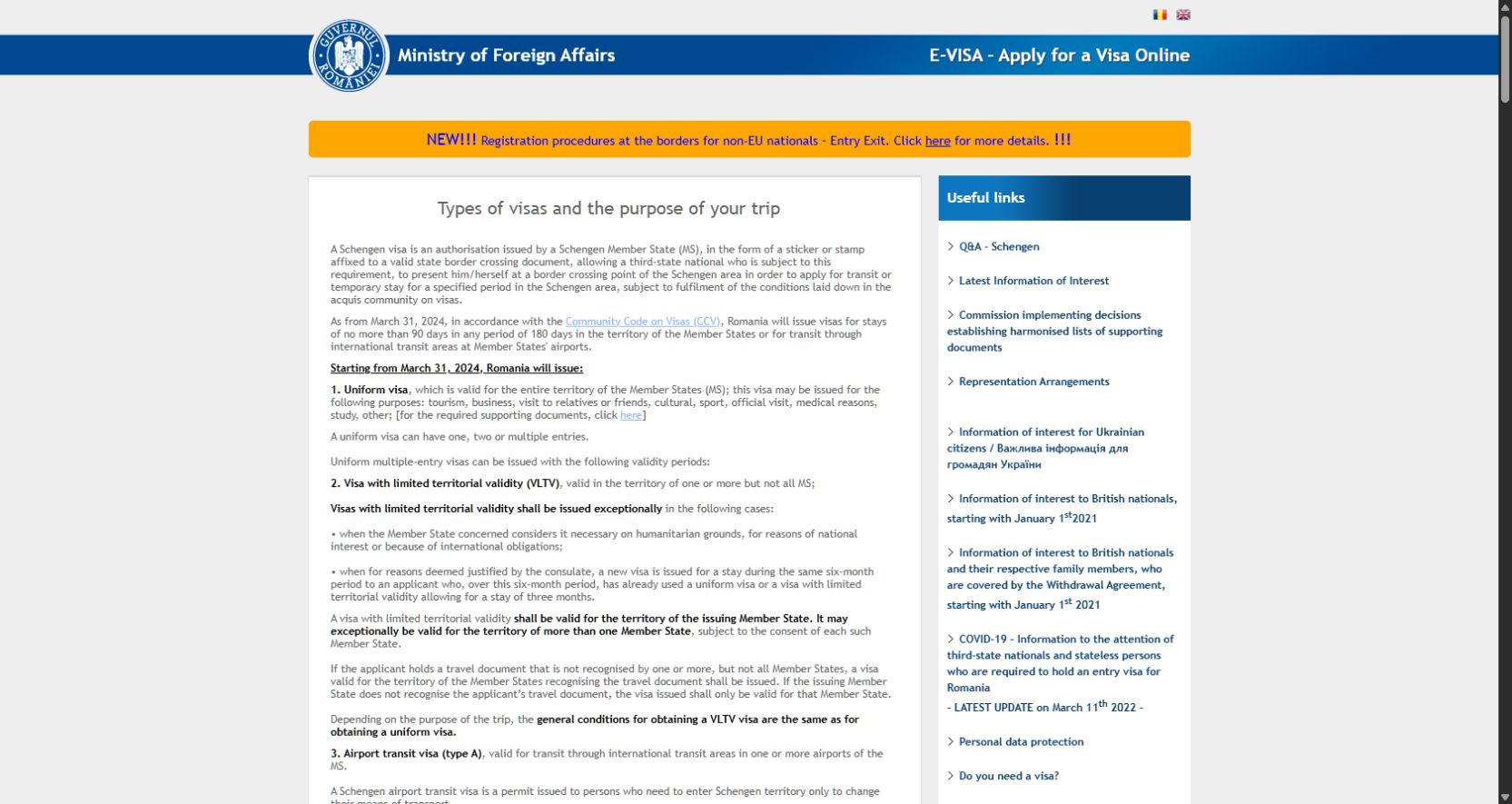
- Use the Ministry of Foreign Affairs eViza site to review visa types and start an online application.
- For digital nomads, the official rule is a dynamic formula: at least three times Romania's average gross monthly salary for each of the six months before application and for the visa period.
Source: Romania Ministry of Foreign Affairs — eViza · Captured: 2026-07
Visa Requirements
Financials
- Income Proof
Employment or business evidence and proof of means meeting the statutory 3x-average-gross-salary formula for each of the six months before application and throughout the visa period. On the 2026 average salary this works out to roughly RON 27,600–27,800 a month (about EUR 5,400–5,550), but the figure moves whenever the national average is republished — confirm it before filing.
- Income Type
Dynamic formula: at least 3x Romania's average gross monthly salary for each of the last 6 months and throughout the visa period
Background & Health
- Health Insurance Required
- Background Check Required
- Minimum Age 18+ years old
Advantages
- • Excellent internet infrastructure - among the fastest in Europe
- • Very affordable cost of living by EU standards
- • No tax on foreign income if staying under 183 days/year
- • An initial 12 months, long enough to settle before renewing
- • Visa is renewable up to 3 years total
- • Pathway to permanent residency and citizenship
- • Dependants can join — can apply for dependent visas. Must meet additional financial requirements
- • Filed through a consulate rather than after arriving as a tourist
- • Central European location - easy travel to EU/Schengen
Disadvantages
- • Moderate income requirement ($3,800/month)
- • Background check required (adds processing time)
- • Cannot apply fully online
- • Romanian language barrier in smaller cities
- • Processing can take 1-2 months
Tax & Legal
Foreign Income
Romania generally does not tax foreign-sourced income for holders of this visa, making it highly attractive for remote workers.
Foreign-sourced income is not taxed for digital nomad visa holders for the first 183 days per year
Local Income
Income earned from local Romania sources is taxable at standard rates.
If you stay more than 183 days in a calendar year, you become a tax resident and may be subject to Romanian income tax on worldwide income (10% flat rate). However, tax treaties may prevent double taxation.
Living in Romania
All ratings use a unified A–D scale. A = best for digital nomads in each category.
Affordable
Numbeo Cost of Living Index: 35/100 (NYC=100, lower=cheaper)
Safe
UNODC Homicide Rate: 1.1/100k population
Good Coverage
WHO Universal Health Coverage Index: 70/100
Excellent for Remote Work
Ookla Speedtest: 269 Mbps median download
High Development
UNDP Human Development Index: 0.866
Continental — cold winters, hot summers
WHO/UNICEF JMP
Basics recommended
Climate classification
Sources: UNDP HDR 2025 · UNODC Homicide Data · WHO UHC 2023 · Numbeo · Ookla · WHO/UNICEF JMP. Updated 2026-08.
Common Questions
What does the Digital Nomad Visa cost to apply for?
Why does the income requirement for Romania keep changing?
How long does the Digital Nomad Visa last?
Can I bring my family on the Digital Nomad Visa?
Is foreign income taxed in Romania on this visa?
Do I have to apply in person for the Digital Nomad Visa?
Does time in Romania use up my Schengen 90/180 days?
Can this route eventually lead to a Romania passport?
What do I need to renew the Digital Nomad Visa?
Which documents cause the most trouble for Romania?
Where to Live & Work
Bucharest
Capital and largest city. Vibrant tech scene, excellent nightlife, surprising architecture mixing old and modern. Often called 'Little Paris' of the East.
Popular Neighborhoods
Old Town (Centru Vechi)
Historic center, pedestrian streets, bars and restaurants, touristy
Best for: Newcomers wanting walkable central location
Romana / Dorobanti
Upscale residential, embassies, parks, quiet
Best for: Professionals and families seeking quality residential area
Floreasca
Modern business district, new developments, shopping
Best for: Those wanting modern apartments and business amenities
Coworking Spaces
Large community, events and workshops
Creative space with childcare available
Tech-focused community
Local Tips
- ● Bucharest has some of Europe's fastest internet - 200+ Mbps common
- ● Traffic can be chaotic - metro is reliable for getting around
- ● Winters are cold (-5°C to -10°C), summers hot (30°C+)
- ● Herastrau Park is perfect for outdoor work and jogging
Cluj-Napoca
Romania's tech capital. Young, vibrant university city in Transylvania. Lower cost of living than Bucharest, strong startup culture, beautiful surroundings.
Popular Neighborhoods
Central / Piata Unirii
Historic center, main square, cafes and culture
Best for: Those wanting to be in the heart of the action
Marasti
Student area, affordable, good local vibe
Best for: Budget-conscious nomads and younger crowd
Coworking Spaces
Popular with local tech community
Part of global Impact Hub network
Local Tips
- ● Cluj is cheaper than Bucharest - 20-30% lower costs
- ● Surrounded by Transylvanian hills - great for hiking
- ● Major tech conferences and events throughout the year
- ● Smaller city feel while still having all amenities
General Tips for Romania
- ● Romania has some of the world's fastest and cheapest internet (often $10-15/month for 1 Gbps)
- ● Cost of living is very low - expect to spend $1,000-1,500/month comfortably
- ● Romanian language uses Latin alphabet, making it easier to learn than other Eastern European languages
- ● Cash is still commonly used, though card acceptance is growing in cities
Prices are approximate and based on publicly available data as of 2026-04. Actual costs vary by individual circumstances and market conditions.
After You Arrive
CNP (Cod Numeric Personal)
Required for opening bank accounts, signing contracts, and official transactions
Bank Account
Can open: Yes
Recommended: ING Bank Romania, Raiffeisen Bank, BCR (Romanian Commercial Bank), BRD
Alternatives: Wise and Revolut work well; many Romanian services accept them
Housing Search
Main platforms: Imobiliare.ro (most popular), Storia.ro, OLX.ro, Airbnb for short-term
- • Furnished apartments common in major cities
- • Typical deposit: 1-2 months
- • Rental contracts should be registered with tax authorities
- • English-speaking agents available in Bucharest and Cluj
What Nobody Tells You
Romania introduced its digital nomad visa in 2021, relatively early in the EU's digital nomad visa wave. The 3x average salary requirement (~€3,500/month) sounds high but Romania's average salary is low, making this one of the more accessible EU options.
Romania is famous for having the fastest internet in Europe and among the fastest globally. Bucharest routinely ranks in global top 10 for internet speed. This is a major draw for remote workers - 1 Gbps fiber costs $10-15/month.
The 183-day tax residency threshold is critical: stay under 183 days and your foreign income isn't taxed. Cross it and Romania's 10% flat income tax applies to worldwide income. Many nomads split time between Romania and neighboring countries.
Romania's average salary is around €800-900/month, making the visa's €3,500 requirement about 4x local wages. You'll live very comfortably - Bucharest 1BR rent is $500-750/month, total monthly costs $1,000-1,500.
Transylvania (yes, Dracula's region) is real and beautiful. Cluj-Napoca, Brașov, and Sibiu are emerging nomad destinations with medieval charm, mountain access, and growing tech scenes.
Income in Context
Visa Requirement
Local Average Wage
$900/mo
Living Costs
The €3,500/month requirement is 4.2x Romania's average salary of ~€800-900 ($900). This puts you in the upper-middle class. Bucharest rent: $450-750 for 1BR. Total monthly costs: $1,000-1,500. You'll live very comfortably at the required income level.
Romania is one of the EU's most affordable countries. Bucharest is the most expensive city, but still cheap by Western standards. Cluj, Timisoara, and Brașov are 20-30% cheaper.
Advanced Questions
Can I work for Romanian companies on the digital nomad visa?
What happens if my visa application is rejected?
Do I need to leave Romania to renew my visa?
Will I pay taxes in Romania?
Is Romania part of the Schengen Area?
Compare Romania with Other Visas
Side-by-side comparisons covering income, duration, tax, and application process.